
Finance & Operations
School closures ahead? Protect your assets and fee balances before closure day
School boards in several states have recently approved closing or consolidating schools. Each closure leaves two financial loose ends: fee balances still owed and school-owned items still assigned to students. Clean records before closure day make the move faster and the audit easier.
When a district closes a school, the building is only part of the transition. Fee balances and school-owned devices, books, and instruments all have to be accounted for. Settling those records early can make the transition smoother and leave a clear trail for auditors.
School closures are moving from planning to approval
Recent K-12 Dive coverage reports school boards voting on closures, with changes starting in the 2027-28 school year:
- Poudre School District (Colorado): the board approved closing or consolidating eight schools between 2027-28 and 2028-29, according to K-12 Dive (Nov. 4, 2026). The article reports projected enrollment averaging 23,566 students from 2025 to 2030 against a capacity of 34,105.
- St. Louis Public Schools (Missouri): the board voted on Nov. 10, 2026 to close nine schools beginning in 2027-28, which reduces the district's school count from 61 to 52, according to K-12 Dive (Nov. 12, 2026).
- Tulsa Public Schools (Oklahoma): the board approved closing or consolidating 17 schools on Oct. 19, 2026, effective 2027-28, according to K-12 Dive (Oct. 21, 2026).
Organizations named are cited from public reporting; no affiliation or endorsement is implied.
What a closure can mean for the business office
Whenever a school closes, the business office inherits some tidy-up work. Fee balances and school-owned items are two places where good records make that work easier. The rest of this post is general guidance for any district facing a closure or consolidation.
Two records to settle before a school closes
1. Fee balances follow the student, not the building
A family with an unpaid athletic fee or yearbook charge still owes it after the school closes. Its record needs to be clear, complete, and easy to find in the district's system rather than in a campus spreadsheet or a retiring bookkeeper's files.
Closing a campus is also a good moment to review what each school is still owed, which waivers and adjustments were approved, and which payments are still unapplied.
2. School-owned items stay assigned until they are returned
Chromebooks, textbooks, instruments, and uniforms keep their value after a school closes. If those items are tracked on a campus-level list, the list can be hard to find once staff move to other buildings.
A district-level record of what is assigned, to which student, and in what condition lets staff plan returns and transfers with confidence. A missing laptop is a replacement cost, so knowing where each device is matters. Our post on slowing device purchases goes deeper on tracking the technology you already own.
Talk to families before the paperwork does
By the time a notice about a fee balance or an unreturned laptop arrives, families may already be thinking about a new school, a new commute, and a new routine.
A few habits keep the tone right:
- Send balance and return notices after the district has shared transition plans, not before.
- Give one phone number and one email for questions about money or equipment.
- Offer payment options for any balance still open, so a closure stays out of collections.
- Confirm in writing when an item is returned or a balance is cleared.
Clear, kind communication also helps the district: families who feel respected are more likely to respond to requests.
Why the timing favors the business office
The approvals reported above start taking effect in 2027-28, so a planning window exists.
Use it in three stages:
- Now to the end of this school year: clean up balances, exceptions, and item lists at the schools on the list.
- Next fall: tell families the return and payment dates, and keep running the same reports to watch progress.
- Closing spring: collect remaining items, settle final fees, and lock the campus's last financial activity.
A school that reaches its last day with clean records tends to leave the business office with fewer loose ends for the next audit.
A closure-ready checklist for the business office
- Snapshot what is owed. Capture open balances for the closing school and for the whole district on the same day.
- Clear the exceptions. Resolve waivers, refunds, and payments with no home while the staff who approved them are still at the school.
- Follow the student. Check that each balance is tied to a student record, so it stays findable after the family moves to a new campus.
- List what is on loan. Record every district-owned item by student and school, with its condition, so returns can be checked.
- Set a return window. Give families and staff firm dates and one contact for questions.
- Close the books on the campus. Send the school's final activity to the ledger and have a second person review it.
- Keep the paper trail. Store who changed what, and when, for the next audit.
Give every step a named owner and a due date. A bookkeeper might own the balance snapshot, a technology coordinator the device list, and a principal the return window. When each person knows their part, the closing campus is not waiting on a single overloaded desk. A short weekly check-in during the final semester keeps small issues from piling up.
The K-12 Audit Readiness Checklist pairs well with this list. Planning for fewer students overall? Our post on fee revenue as enrollment shifts covers the budget side.
Where SchoolBanks fits
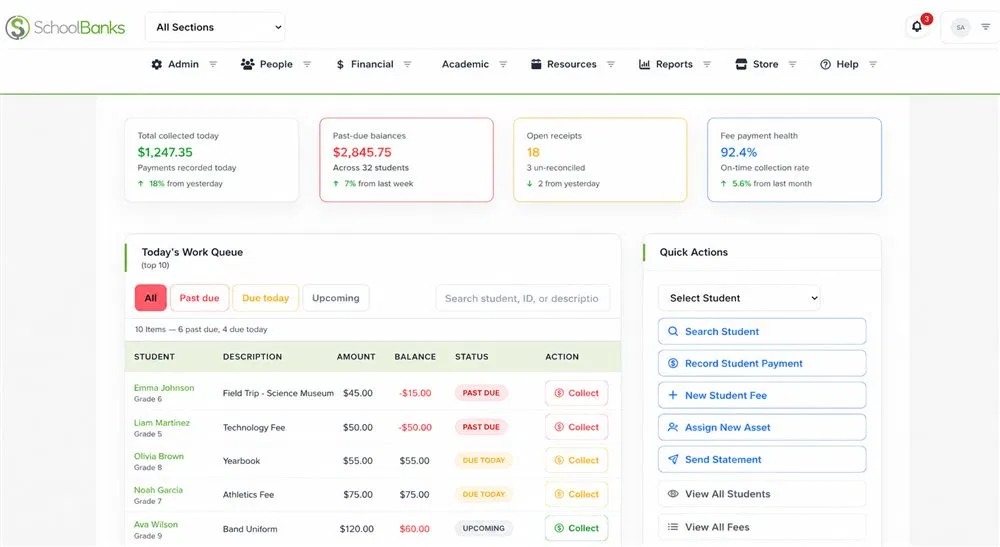
A closure goes smoothly when one system can answer the questions above in minutes. SchoolBanks gives the business office that starting point.
- Balances by campus or district. Pull what is owed at the closing school, or across all schools, and send reminders from the same place. Details are on the Fee Management page.
- A shared list of district-owned items. Each Chromebook, textbook, or instrument is tied to both a student and a school, so a closing campus has a ready-made return list. Details are on the Assets & Inventory page.
- A clean handoff to accounting. Final activity for the closing school flows into the ledger with a record of who approved each change. See Reporting.
Pull two reports this month
You do not need a vote on the calendar to get ready. Run one balance report and one assigned-item list now. Together they show how much work a closure would take and which campuses already have tidy records.
Want help reading those reports? Book a SchoolBanks demo and bring your own questions, or try the Asset Loss Calculator to size the cost of unreturned items.
Sources
- K-12 Dive, "Fort Collins-area district to close, consolidate 8 schools" (about Poudre School District), Nov. 4, 2026. k12dive.com
- K-12 Dive, "St. Louis school board votes to close 9 schools," Nov. 12, 2026. k12dive.com
- K-12 Dive, "Tulsa Public Schools will close or consolidate 17 schools in 2027-28," Oct. 21, 2026. k12dive.com
Organizations named are cited from public reporting; no affiliation or endorsement is implied.